
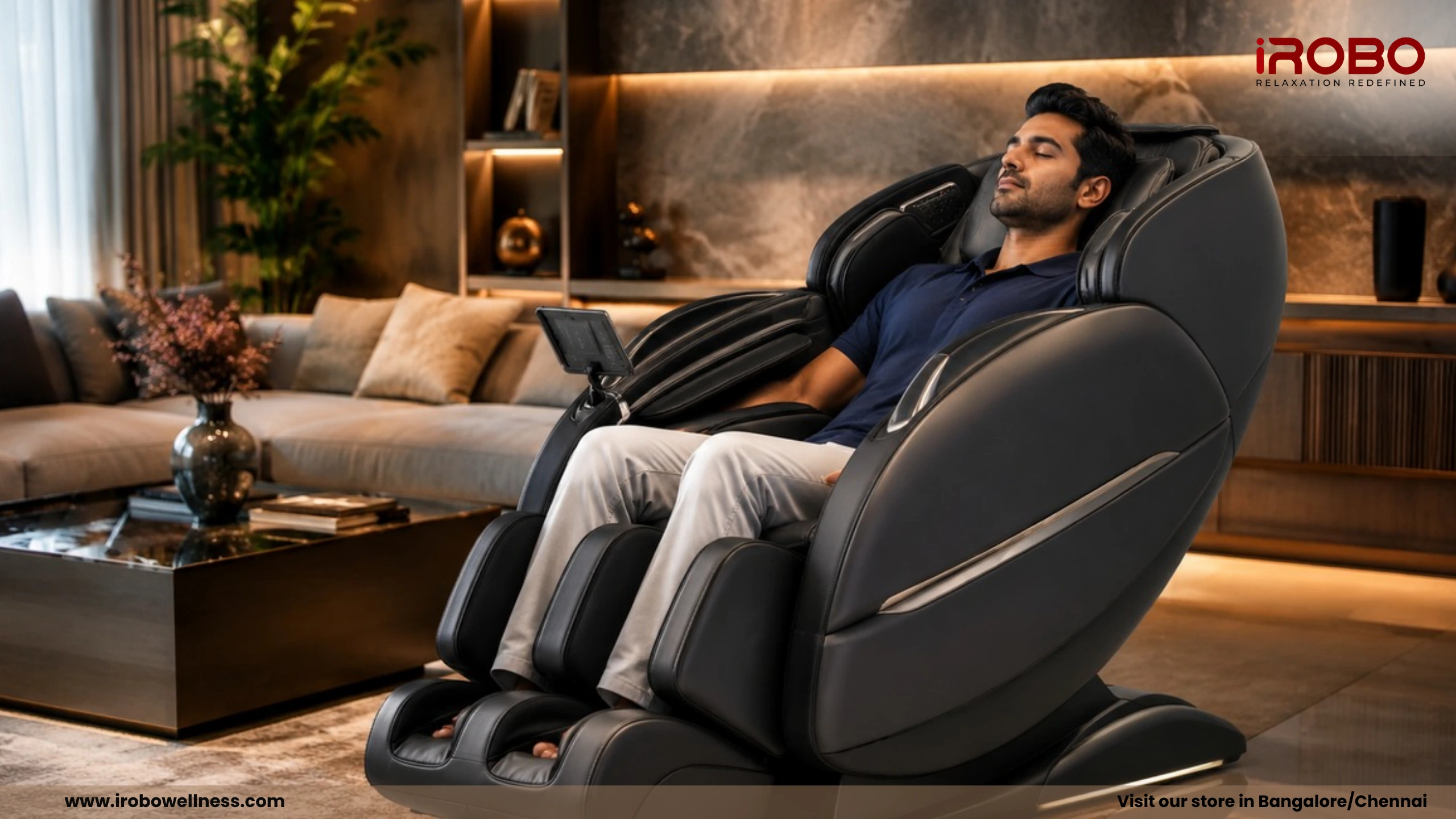
Quick answer: to choose the right massage chair, check six things in this order — track length, 3D vs 4D, wall clearance, number of users, heat therapy, and who services it. Nail those and the rest is marketing. Get one wrong and you'll notice every single day.
Here's the uncomfortable truth about buying a massage chair: almost nobody regrets the money. They regret the model.
They bought the one with 30 programs and use three of them. Or the one that needed 40 cm of wall space in a flat that had 12. Or the one that stops at the mid-back when their pain lives in the lower back.
So let's skip the spec-sheet noise. Six decisions actually matter. Here they are, in the order you should make them.
1. What Track Does the Chair Use?
Start here, because the track decides how much of your body gets massaged. An SL track curves with your spine from your neck all the way to your glutes. A short track stops at your mid-back — which is exactly where most people's pain isn't.
If your pain is lower back, hips or sciatic, a short track is a waste of money no matter how good the rest of the chair is. It physically cannot reach the problem.
- S track — follows the natural S-curve of your upper and mid spine. Good coverage up top, nothing below.
- L track — extends down under the seat toward the glutes and hamstrings.
- SL track — both, in one continuous run. This is what you want.
- Track length — ask for the number in centimetres. The iUltima runs 137 cm, the longest in our range. Taller users should not compromise here.
You can read about Understanding Massage Chair Tracks here.
2. Do You Actually Need 4D, or Is 3D Enough?
3D rollers adjust how deep they press. 4D rollers adjust depth and rhythm — they speed up, slow down and pause the way a human therapist does. That variation is the difference between a massage and a machine running a loop on your spine.
Ten minutes into a session, 3D starts to feel repetitive. 4D doesn't, because it never does quite the same thing twice. If you plan to use the chair daily, this is the upgrade worth paying for.
The good news: every current iRobo chair, right down to the iEco at ₹1,21,990, includes 4D. You don't need to spend four lakh to get it.
3. How Much Space Does It Actually Need?
Forget the chair's footprint — measure the recline space. Older chairs slide backwards to recline and need 40–50 cm of clear wall. Modern space-saving chairs slide forward instead and need as little as 5 cm.
This is the single most common measuring mistake, and it's the one that turns a wellness purchase into an expensive obstacle in your living room.
- Measure the wall gap you can spare, not just the floor area
- Check the doorway and lift dimensions before delivery day, not after
- Leave room for the legrest to extend forward — it grows when reclined
- Ask specifically about wall clearance. "Space-saving" means nothing without a number
4. How Many People Will Use It?
If it's just you, buy for your body. If it's a family of four with a 5'2" mother and a 6'1" son, you need body scanning and saved user profiles — otherwise everyone spends the first two minutes of every session re-adjusting.
Body scan reads your shoulder position and height, then maps the rollers to your spine rather than an average one. Memory profiles save each person's settings so nobody overwrites anybody.
The iUltima Pro stores six separate user profiles, which is the most in the range and the reason it's our most popular family chair.
5. Which Features Are Worth Paying For?
Heat therapy and zero-gravity recline earn their place. Everything else is a preference, not a requirement.
Genuinely worth it:
- Lumbar heat — warm muscles release faster. It makes every other feature work better, and it's the one thing users miss most when it's absent.
- Zero-gravity recline — distributes your body weight so the spine isn't carrying it, which is why the same roller pressure feels deeper in ZG than upright.
- Foot and calf rollers — if you're on your feet all day, this is the part you'll actually crave.
Nice, but don't let it decide the purchase:
- Voice control — lovely when you're half asleep, not essential
- Bluetooth speakers — you probably have better ones
- A 30-programme library — most people settle on two or three within a fortnight
- Wireless charging — a genuinely nice touch, not a reason to spend an extra lakh
6. Who Installs It, and Who Services It?
This is the boring question that decides whether you're happy in year three. Ask who actually comes to your house — the brand's own team, or a third-party partner network?
A massage chair is a piece of machinery with motors, rollers and airbags. Something will eventually need attention. When it does, "we'll raise a ticket with our partner" is a very different answer from "our technician will be there Thursday." Every iRobo chair includes a 1-year manufacturer warranty plus 4 years of service warranty, with installation and service handled by our own team.
What Should You Budget?
A proper full-body massage chair in India costs between ₹79,990 and ₹4,50,000. Below that range you're usually looking at a vibration recliner, not a massage chair.
| Budget | What you get | Start here |
|---|---|---|
| Under ₹1.5L | 4D massage, SL track, dual zero-gravity, heat | iEco — ₹1,21,990 |
| ₹1.5L – ₹2.5L | Adds body scan, voice control, more programmes | iNap Pro — ₹1,90,000 |
| ₹2.5L – ₹3.5L | Adds memory profiles, multi-level heat, 3 ZG modes | iUltima Pro — ₹3,25,000 |
| ₹3.5L+ | AI body scan, longest tracks, head massage, everything | iDream Pro — ₹4,50,000 |
One piece of advice we'd give our own family: spend the money on track length and 4D. Skip the programme count. A chair that reaches your lower back with good rollers will beat a chair with twice the presets, every single time.
Your 60-Second Checklist Before You Pay
- Is it an SL track, and how long in cm?
- Is it 4D, or only 3D?
- Exactly how much wall clearance does it need to recline?
- Does it have body scan? How many users can it remember?
- Does it have lumbar heat and zero-gravity?
- Who installs it, who services it, and for how long?
- Have you actually sat in it?
The Only Test That Really Counts
You can research a massage chair for three weeks and still be wrong, because bodies are specific and spec sheets aren't. Fifteen minutes in the chair tells you more than every review on the internet.
Book a Free Demo — Sit In Every Chair, Decide Nothing
Try the full range back-to-back at our Experience Centres in Bangalore and Chennai. No pressure, no obligation.
Related reading:
1. Best Massage Chair in India 2026 — Prices & Expert Picks.
2. Is a Massage Chair Worth the Money? The Honest Maths.
3. Massage Chairs for Back Pain — Do They Really Work?
4. Can a Massage Chair Help You Sleep Better?
Buying locally? We deliver and install across Bangalore, Chennai, Hyderabad, Delhi, Mumbai, Pune and the rest of India.
Frequently Asked Questions
How do I choose the right massage chair for my home?
Check six things in order: track type and length, whether it's 3D or 4D, how much wall clearance it needs to recline, how many people will use it, whether it has lumbar heat and zero-gravity, and who handles installation and service. Get those right and everything else is personal preference.
What is an SL track and why does it matter?
An SL track combines the S-curve of the upper spine with an L-shaped extension under the seat, so the rollers travel from your neck all the way to your glutes in one continuous run. Shorter tracks stop at the mid-back, which means they never reach the lower back where most people's pain actually sits.
Is a 4D massage chair worth the extra money over 3D?
Yes, if you'll use it daily. 3D adjusts roller depth; 4D adjusts depth and rhythm, so it speeds up, slows down and pauses like a real therapist. 3D starts feeling repetitive around the ten-minute mark. Every current iRobo chair includes 4D, starting from ₹1,21,990.
How much space do I need for a massage chair?
Measure the wall clearance, not just floor space. Older designs recline backwards and need 40–50 cm behind them. Space-saving chairs slide forward instead — the iUltima needs just 5 cm of wall clearance to recline fully. Also check your doorway and lift before delivery day.
How much should I budget for a good massage chair in India?
Between ₹79,990 and ₹4,50,000. Under ₹1.5 lakh gets you genuine 4D with an SL track and heat. ₹2.5–3.5 lakh adds memory profiles and multi-level heating. Above ₹3.5 lakh you're paying for AI body scanning, the longest tracks and extras like head massage.
Which features can I safely skip?
Large programme libraries, Bluetooth speakers and wireless charging are pleasant but rarely decisive — most owners settle on two or three programmes within a fortnight. Don't skip lumbar heat, zero-gravity recline or a full-length SL track; those three change how the chair feels every single session.
Can I try a massage chair before buying?
Yes, and you should. Book a free demo at our Experience Centres in Bangalore or Chennai and sit in the full range back-to-back. Fifteen minutes in the chair tells you more than three weeks of research, because comfort is specific to your body.