Most articles about building a wellness corner will tell you to add warm lighting, a plant, a diffuser and a soft throw. All fine advice. None of it addresses the reason most of these corners quietly turn into laundry-drying zones by the second month.
The two things that actually decide whether a wellness corner works are unglamorous: whether the chair physically fits the space when reclined, and whether the corner sits somewhere your daily routine already passes through. Get those right and the lighting is a bonus. Get them wrong and no amount of eucalyptus oil will save it.
The Short Answer
A home wellness corner needs three things a massage chair actually requires: enough floor space for the chair fully reclined, a power point within reach, and a location quiet enough that you'll use it without being interrupted. Everything else — lighting, scent, textiles — is atmosphere layered on top.
Plan for roughly 2 × 4 feet of usable floor area minimum, plus recline clearance behind the chair unless it has a space-saving mechanism. Then place it somewhere you already walk past every evening. Corners you have to make a special trip to reach don't get used.

Why Most Wellness Corners Get Abandoned
It's rarely about the chair. It's about placement, and the failure follows a predictable pattern.
The corner is too far from your routine. A spare bedroom on another floor sounds ideal — private, quiet, undisturbed. In practice, a space you have to decide to visit competes with everything else you could be doing. A corner you walk past on the way to change out of work clothes doesn't need a decision.
The chair doesn't recline properly where it sits. If there's a wall or a bed 20cm behind it, you never get to zero gravity, which is the position that makes longer sessions comfortable. So sessions stay short, then stop.
The space has a competing job. A corner of the living room that's also where guests sit, or where the kids play, means the chair gets used only when the house is empty. Which is not often.
The design test that matters: can you get into the chair, fully reclined, within 60 seconds of walking through your front door, without moving anything or asking anyone to shift? If yes, you'll use it daily. If no, fix the placement before you buy a single candle.
Step 1: Measure Before You Choose the Corner
This is the step the "cosy corner" articles skip entirely, and it's the one that determines everything. A full-body massage chair is a substantial piece of machinery, and it needs more room reclined than it does upright.
| What to measure | Typical requirement | Why it matters |
|---|---|---|
| Floor width | 75–90 cm | The chair's widest point, usually across the armrests |
| Floor length, upright | 140–165 cm | What it occupies when not in use — this is the footprint you live with |
| Floor length, reclined | 180–200 cm | The number that actually decides if the corner works |
| Wall clearance behind | 5–15 cm with space-saving recline; 40–60 cm without | The single biggest variable between models. Ask before you buy. |
| Side clearance | 15–20 cm each side | Arm airbags need room to inflate, and you need room to get in and out |
| Power point distance | Within 1.5 m | A trailing extension cord across a walkway is a trip hazard, not a design choice |
| Door and stairwell width | Measure every doorway on the route | Delivery day is the wrong time to discover the lift is too small |
These are typical ranges across full-body chairs. Dimensions vary by model — always confirm the exact figures for the chair you're considering, reclined as well as upright.
The masking-tape method: before committing, mark the reclined footprint on your floor with tape and leave it there for two days. You'll learn more about whether the corner works from walking around that rectangle than from any amount of measuring on paper.
Step 2: The Delivery Reality Check
Nobody covers this, and it's where the plans go wrong. A full-body massage chair typically weighs somewhere between 80 and 120 kg, and while most arrive in two or three sections for assembly, those sections are still heavy and awkward.
- Lift dimensions — measure the internal depth of your building's lift, not just the door. In many older Bangalore apartment buildings the lift is the blocker.
- Stairwell turns — a straight flight is fine. A tight landing with a 180° turn is where things stop.
- Doorway widths — standard Indian internal doors run around 75–80 cm. Usually workable, but check the narrowest one on the route.
- Society permissions — some apartment associations restrict large deliveries to certain hours. Worth a phone call before scheduling.
- Floor type — on tile or wooden flooring, use protective pads under the base. Wheeling a heavy chair across polished tiles leaves marks.
Any decent supplier will walk through this with you before delivery day. If nobody asks about your lift, ask them.
Step 3: Choose the Room
Bedroom corner
Best for: most people. It's private, it's on the route to changing out of work clothes, and evening use fits naturally before bed.
Watch for: recline clearance if the bed is close. Measure from the chair back to the bed frame, not to the wall.
Living room corner
Best for: households where several people will use the chair, and homes without a spare corner elsewhere.
Watch for: it becomes semi-public. Some people won't relax properly with family passing through. Be honest about whether that's you.
Balcony or enclosed sit-out
Best for: homes with a genuinely covered, enclosed balcony and good airflow.
Watch for: the big one. Direct sun degrades upholstery, monsoon humidity is hard on electronics, and dust accumulation is constant. Only viable if fully enclosed and weather-protected.
Spare room or home office
Best for: anyone working from home who wants a genuine break between calls.
Watch for: if the room isn't on your daily path, usage drops off. Pair it with something you already do there.
Step 4: Light It Properly
Lighting matters more than the atmosphere-first articles suggest, but for a practical reason: overhead ceiling light shining directly into your eyes when reclined is genuinely unpleasant, and it's the reason some people never use the chair fully reclined at all.
- Never overhead. Once you're at 130 degrees, you're looking straight up. Position light sources beside or behind the chair.
- Warm temperature. Aim for around 2700K rather than the 4000K+ of typical Indian tube lighting. Warm light signals wind-down.
- Dimmable if possible. A floor lamp with a dimmer beside the chair covers both evening use and reading.
- Keep the switch reachable. From the reclined position. Or use a smart bulb you can control by voice.
Step 5: Add the Sensory Layer
This is where the atmosphere advice belongs — after the practical decisions, not instead of them.
- Sound — many chairs include Bluetooth speakers in the headrest. Otherwise a small speaker within reach. Note that massage chair motors make noise; ambient sound helps mask it.
- Scent — a diffuser on a side table. Keep it away from the chair's electronics and out of tipping range.
- Texture — a light throw for after the session, when your body temperature drops slightly. A rug under the chair also reduces floor marking.
- Sight — one plant, or one piece of art at eye level when reclined. Not a gallery wall. You'll be looking up, not around.
- A small side table — for water, a phone, the remote. Genuinely the most-used accessory in any wellness corner.
Step 6: Attach It to a Habit You Already Have
The single best predictor of whether a wellness corner survives is whether the session is attached to an existing routine rather than sitting as a standalone intention.
"I'll use it every evening" is a plan that competes with everything else. "I use it while the rice cooks" or "I use it after my shower, before dinner" is a plan that runs on autopilot, because the trigger already exists.
After work, before dinner
Fifteen minutes between changing clothes and eating. The most reliable slot for most people, because the transition already exists.
Post-workout
Attached to something you already do at a fixed time. Calf and foot programs suit this window.
Pre-sleep wind-down
Twenty minutes before bed as part of an existing routine. Many people find it helps them settle, though this varies person to person.
Start with 15 minutes, not 40. A short session you complete daily beats a long one you skip.
What a Massage Chair Adds to a Wellness Space
Worth being straight about what the chair does and doesn't do here, since this category attracts a lot of overstatement.
What it reliably provides: a comfortable, supported position that takes load off your spine, targeted roller and airbag work on the areas that carry the day's tension, and — perhaps most usefully — a physical reason to sit still for fifteen minutes without a screen. That last one is underrated. Most people don't struggle to want to relax; they struggle to have somewhere that makes stopping easy.
What it doesn't do: treat medical conditions, guarantee better sleep, or fix posture. Many users report feeling less tense and sleeping more easily, and those reports are worth something — but they're individual experiences rather than assured outcomes, and any brand telling you otherwise is overselling.
If you're still deciding between chair types, our comparison of a massage chair versus a recliner covers which one suits which purpose.
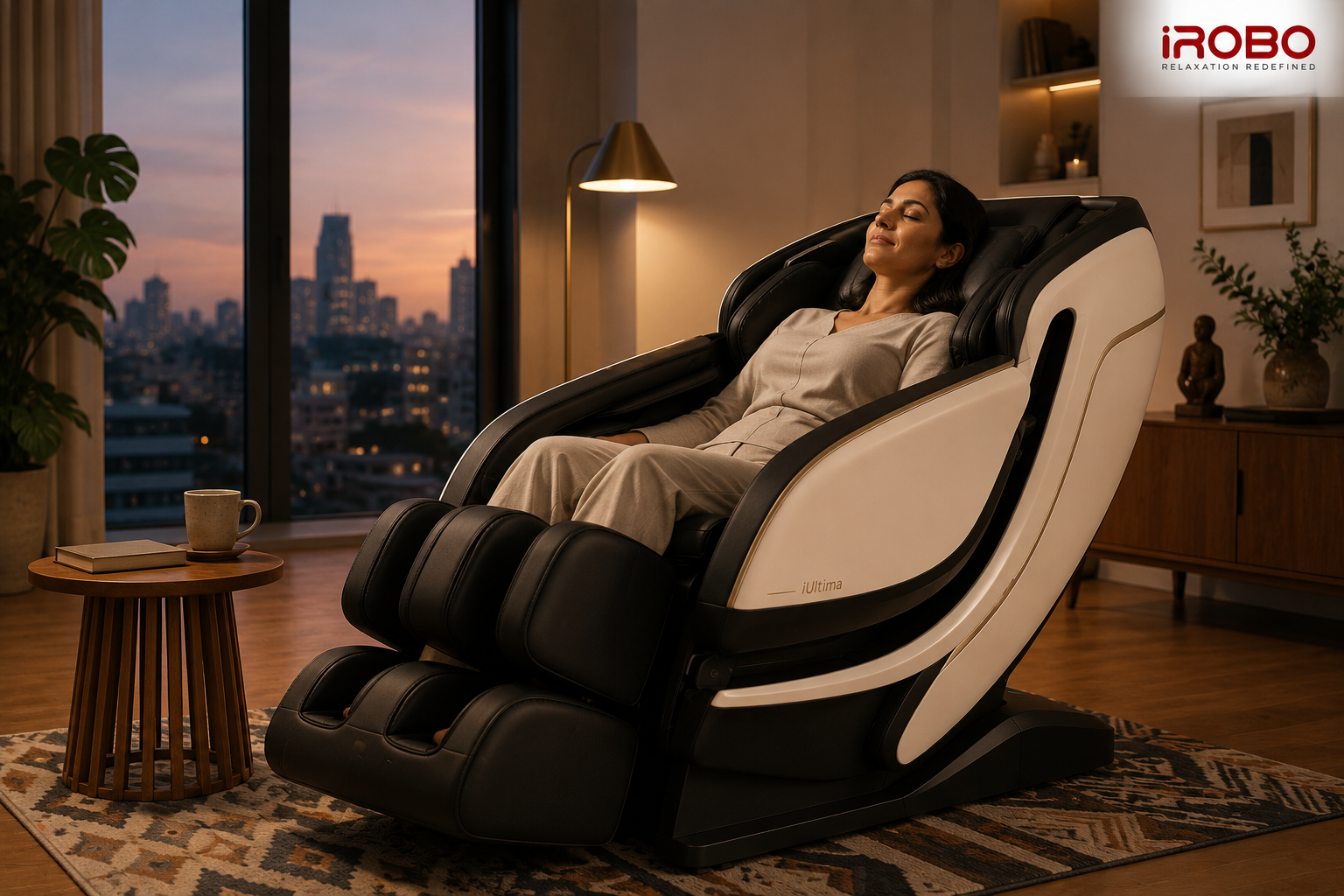
Living With It: The Indian Home Specifics
- Humidity and monsoon — keep the chair away from windows that get driven rain. Synthetic leather handles humidity reasonably well, but standing moisture is a different matter.
- Dust — a genuine factor in most Indian cities. Wipe down weekly; a light cover between uses helps if the corner is near a window or balcony door.
- Direct sunlight — the most common cause of premature upholstery ageing. If the corner gets afternoon sun, use a curtain or move the chair.
- Power supply — check whether your model needs a 5A or 15A socket, and whether it's recommended to run it through a stabiliser. Worth asking directly if your area sees voltage fluctuation.
- Air conditioning — don't place the chair directly under an AC vent. A cold draft on your neck cancels out most of what the heat function is doing.
- Servicing access — leave enough clearance that a technician can access the back and base without dismantling the corner. Check service availability in your city before you buy.
Choosing a Chair That Fits the Corner You Have
Space is usually the real constraint in Indian homes, not budget. Our range of massage chairs spans compact models designed for tighter corners through to full-size flagships, with prices from ₹79,990 to ₹4,50,000. [[VERIFY BEFORE PUBLISHING]]
- iEco FR & iEco — the accessible entry point, and the easiest to accommodate
- iNap Pro & iElegant — compact footprint, straightforward daily use
- iRoyal Pro & iUnique — advanced features in a smaller footprint
- iDream Pro & iUltima — full-size flagships; plan the space properly for these
Bring your measurements to the showroom. Room dimensions, the wall the chair will sit against, and a photo of the corner. Our team can tell you in two minutes which models will physically work — which is a faster route to the right chair than browsing by feature list.
Plan Your Corner Properly
Bring your room measurements to a free demo and we'll tell you which chairs actually fit — before you fall in love with one that doesn't.
Or call +91 80956 46566.
Your Wellness Corner Checklist
- Measure the reclined length, not just the upright footprint.
- Confirm wall clearance for your specific model — space-saving or not.
- Tape the footprint on the floor and live with it for two days.
- Check the delivery route — lift, stairwell, every doorway.
- Find the power point and confirm the socket rating your model needs.
- Pick a corner on your daily path, not one you have to visit.
- Position lighting to the side, never overhead.
- Add a side table within arm's reach of the reclined position.
- Avoid direct sun and AC drafts when choosing the exact spot.
- Attach the session to an existing habit before you promise yourself a new one.
- Leave servicing access around the back and base.
- Start at 15 minutes daily and let it grow from there.
Final Verdict
A wellness corner isn't really a decorating project. It's a logistics problem with a decorating layer on top — and the people whose corners still get used a year later are the ones who solved the logistics first.
Measure the space reclined. Confirm the delivery route. Put the chair somewhere your evening already takes you. Then add the warm lamp, the side table, the plant, the throw — because those genuinely do make the space somewhere you want to be.
The best home wellness corner isn't the most beautiful one. It's the one that's easy enough to reach that you're still sitting in it next winter.
A note on health: massage chairs are wellness products designed to support relaxation and may provide temporary relief from everyday muscle tension. They aren't medical devices and don't treat or cure medical conditions. If you're pregnant, recovering from injury or surgery, or managing a spinal condition, osteoporosis, blood pressure issues or a heart condition, check with your doctor before regular use.
Frequently Asked Questions
How much space does a massage chair need in a home?
Plan for roughly 75–90 cm width and 180–200 cm length when fully reclined, plus 15–20 cm clearance on each side for the arm airbags. Wall clearance behind varies enormously by model — 5–15 cm for space-saving designs, 40–60 cm without. Confirm the exact reclined dimensions for your model before choosing the corner.
Can I put a massage chair in a small apartment?
Yes, with two conditions: choose a model with space-saving recline, and measure the reclined footprint rather than the upright one. Compact chairs work in most 2BHK layouts. The masking-tape test — marking the footprint on your floor for a couple of days — is the most reliable way to check before buying.
Where is the best place to put a massage chair at home?
A bedroom corner suits most people, since it's private and sits on the route you already take when you get home. Living rooms work for shared households. The deciding factor is whether the spot is on your daily path — corners you have to make a special trip to reach tend to stop getting used.
Can a massage chair go on a balcony?
Only if the balcony is fully enclosed and weather-protected. Direct sunlight ages upholstery quickly, monsoon humidity is hard on the electronics, and dust builds up constantly. An enclosed sit-out with good airflow can work; an open balcony is not a good idea.
How heavy is a massage chair, and will it fit through my door?
Full-body chairs typically weigh 80–120 kg and usually arrive in sections for assembly. Standard Indian internal doors around 75–80 cm are generally fine, but measure every doorway, the lift interior and any stairwell turns on the delivery route beforehand. Suppliers should ask about this before scheduling.
Does a massage chair need a special power point?
Most run on a standard domestic socket, but check whether your model needs a 5A or 15A point and whether a stabiliser is recommended — worth asking if your area sees voltage fluctuation. Keep the chair within about 1.5 m of the socket so no cable crosses a walkway.
How long should I use a massage chair each day?
Fifteen to twenty minutes daily is a realistic starting point, and most chairs auto-stop after a set duration. A shorter session you actually complete every day is more useful than a long one you skip. Build up gradually rather than starting with the longest program.
What else do I need in a wellness corner besides the chair?
A side table within arm's reach is the most-used addition — for water, phone and remote. Beyond that: a floor lamp positioned to the side rather than overhead, a light throw, and a rug to protect the flooring. Everything else is optional atmosphere.
How do I stop my wellness corner from becoming a dumping ground?
Give the space one job and keep storage out of it. The more common failure, though, is placement: corners that aren't on a daily route stop getting used, and unused spaces attract clutter. Attaching the session to a habit you already have — after your shower, before dinner — keeps it in circulation.
How do I maintain a massage chair at home?
Wipe the upholstery weekly with a soft dry cloth, keep it out of direct sunlight, and avoid placing it under an AC vent or near windows that take driven rain. Leave enough clearance around the back and base for a technician to access it, and check that service support is available in your city.