
Massage chair spec sheets have started to read like smartphone launches. 4D rollers, AI body scanning, SL-track, zero gravity, voice control, app pairing, Bluetooth audio. Every brand claims all of it. Almost nobody explains which parts you'll actually notice once you're sitting in the chair.
This guide does that — what each technology genuinely does, which features change the massage itself, and how to judge a chair without taking the marketing on trust.
The Short Answer
A next-gen massage chair is one that adapts to your body instead of running a fixed routine. The technologies that do this are body scanning, 3D or 4D rollers, and an L-track or SL-track that follows your spine past the lower back. Those three decide how the massage feels.
Everything else — voice control, app pairing, Bluetooth speakers, USB ports — improves convenience, not massage quality. Both categories are worth having. Only the first is worth paying a premium for.
Why Massage Chair Technology Is So Confusing
Three things make this category harder to shop than it should be.
The terms aren't standardised. "AI" on one brand's spec sheet means a genuine body scan that repositions the rollers for your height. On another, it means five preset programs with a clever name. There's no regulator policing the word.
Feature counts get used as a proxy for quality. A chair advertising 40 airbags sounds more capable than one advertising 24. It might just have smaller, weaker airbags. Quantity is easy to print on a box. Pressure quality isn't.
The important stuff is invisible in photos. How smoothly rollers transition from your neck to your lower back, whether the calf massage actually reaches your Achilles, how loud the motor is at full intensity — none of it shows up in a product listing. It only shows up when you sit down.
So the useful skill isn't memorising specs. It's knowing which specs correspond to something you'll feel.
The Three Technologies That Change the Massage
1. Body Scanning
Sensors map your shoulder, spine and hip position, then reposition the rollers to your frame. Without it, the chair massages an average-sized body — and no intensity setting fixes a positioning problem.
2. Roller Dimension
2D moves in a flat plane. 3D adds depth, which is what makes intensity control meaningful. 4D adds varying speed and rhythm within each stroke.
3. Track Length
S-track covers neck to lower back. L-track continues under the seat to glutes and hamstrings. SL-track does both — and decides how much of you is included at all.
Core Massage Technology, Explained
What are 2D, 3D and 4D rollers?
The number refers to how many directions the rollers can move.
- 2D — up-down and side-to-side, in a flat plane. Consistent, fairly gentle, no depth adjustment.
- 3D — adds forward-and-back movement, so rollers can press deeper or ease off. This is where adjustable intensity becomes real rather than nominal.
- 4D — adds variable speed and rhythm within a single stroke, so pressure builds and releases the way a therapist's hands do instead of running at one constant tempo.
Why it matters: the jump from 2D to 3D is the one you'll feel most — it's the difference between a massage that happens to you and one you can dial in. The jump from 3D to 4D is subtler, and matters most to people who use the chair daily and get bored of a fixed cadence. Our explainer on 4D massage chair technology covers the mechanics.
Verdict: 3D is close to essential at the premium end. 4D is a genuine upgrade, not a gimmick — but only if the underlying massage is already good.
3D adds depth. 4D adds rhythm within each stroke.
What is an S-track, L-track and SL-track?
The track is the rail the rollers travel along. Its shape decides how much of you gets massaged.
- S-track — follows the natural S-curve of the spine, neck to lower back. Good spinal contact, stops at the waist.
- L-track — continues past the lower back and under the seat, covering glutes and hamstrings.
- SL-track — combines both: spinal curve up top, extended coverage below.
Why it matters: if you sit for a living, your glutes and hip flexors are doing as much silent suffering as your shoulders. An S-track will never touch them. This single spec decides whether roughly a third of your body is included. More in our guide to massage chair tracks.
Verdict: must-have. Of every spec on the sheet, track length changes coverage the most.
What is body scanning in a massage chair?
Before the session starts, sensors in the backrest run down your spine to locate your shoulders, neck and hip position, then move the rollers to match.
Why it matters: a chair without scanning massages an average-sized person. If you're 5'2" or 6'2", the shoulder rollers land on your neck or your shoulder blades instead of your shoulders. It matters even more in a household where several people share one chair.
Verdict: must-have, and the spec most often overlooked by buyers focused on roller counts.
Massage techniques and intensity range
Most chairs offer some mix of kneading, tapping, shiatsu, rolling and a combined mode. What separates chairs isn't how many techniques are listed — it's how wide the usable intensity range is.
A chair whose gentlest setting is still too firm for an older parent, or whose strongest setting feels light to a regular gym-goer, has a narrow range no matter how many program names appear on the remote. Test the extremes, not the middle.
Positioning and Recovery Technology
What does zero gravity actually do?
Zero gravity reclines you so your knees sit at or above heart level, distributing your weight along the whole backrest instead of concentrating it on your lower spine.
Why it matters: two reasons, and the second is the one people miss. It takes compressive load off the lower back, and it presses your back more firmly into the rollers — so the same program feels noticeably deeper in zero gravity than upright. It's a positioning feature that quietly upgrades the massage.
Verdict: must-have on any chair bought primarily for back relief. Look for two or three stages rather than one, since the ideal angle varies by person.
Heat therapy and lumbar heat zones
Warming elements, usually in the lumbar region and sometimes the footrest, applied before or during the massage.
Why it matters: warmth helps muscles relax, so the roller work meets less resistance. Most valuable in the first few minutes of a session, and for anyone who finds deep massage uncomfortable on cold, tight muscles. A comfort multiplier rather than a headline feature.
Verdict: premium feature with real value. Not a reason to choose a chair on its own.
Air compression: how airbags change the experience
Airbags inflate and release around shoulders, arms, hips, calves and feet, producing a squeeze-and-release rather than a rolling pressure.
Why it matters: rollers can't work your arms, calves or feet — the geometry doesn't allow it. Airbags are the only way those areas get included. If you stand all day, or run, calf and foot compression may end up being the part you use most.
Verdict: must-have for full-body coverage. Ignore the airbag count; judge the pressure and how well the leg unit fits your height.
Foot, calf and sole massage
Roller or acupressure nodes under the soles, combined with calf compression, and on better chairs a leg rest that extends for taller users. A leg rest that's too short leaves your heels hanging off the end, which makes the whole lower-body program useless. That's a fit issue, not a feature issue, and it's invisible online.
Smart Technology: Convenience, Not Massage Quality
This is where marketing budgets get spent. All of it is genuinely nice. None of it changes how the massage feels.
Voice control and smart home compatibility
Start, pause or change programs by speaking, sometimes via Alexa or Google Assistant.
Reality check: useful precisely when you're mid-session, fully reclined, and reaching for the remote means undoing the position you just got comfortable in. That's a real moment. It's also the only one.
App control and custom programs
A smartphone app for choosing modes, durations and target zones, often with saveable routines.
Reality check: the app itself is minor. The memory profiles underneath it are not. In a household where four people share one chair with different heights and pressure preferences, saved profiles are the difference between everyone using it and everyone reconfiguring it every time. Judge the profiles, not the interface.
Bluetooth audio
Reality check: a nice touch that costs the manufacturer very little. Your headphones are almost certainly better. Never let this break a tie between two chairs.
Touchscreen remotes and controls
Reality check: more underrated than it sounds. A confusing remote is the single most common reason a massage chair ends up permanently stuck on one program. If a parent or grandparent will use it, hand them the remote during the demo and watch what happens. If they need help, that's data.
Comfort and Convenience Features
- Space-saving recline — the chair slides forward as it reclines, needing a few centimetres of wall clearance instead of half a metre. In an Indian apartment this frequently decides whether the chair fits the room at all.
- Memory settings — genuinely valuable in shared households, as above.
- Upholstery quality — this one ages. Cheaper synthetic leather cracks at the stress points within a few years of daily use. Check the seams and the areas that flex.
- Adjustable width and leg extension — a fit feature disguised as a comfort feature. Matters more than most of the smart tech above.
- USB charging — convenient, trivial.
Massage Chair Feature Comparison
| Feature | What it does | Why it matters | Priority |
|---|---|---|---|
| SL-track | Extends the roller path from neck to glutes and hamstrings | Decides how much of your body is actually massaged | Must-have |
| Body scanning | Maps your frame and repositions rollers before the session | Ensures rollers land on your shoulders, not your neck | Must-have |
| 3D rollers | Adds forward-back depth adjustment | Makes intensity control meaningful rather than cosmetic | Must-have |
| Zero gravity | Reclines with knees at or above heart level | Reduces spinal load and deepens roller contact | Must-have |
| Air compression | Airbags squeeze arms, hips, calves and feet | The only way limbs get included at all | Must-have |
| 4D rollers | Varies speed and rhythm within each stroke | More natural pacing for daily users | Premium |
| Heat therapy | Warms lumbar area and sometimes the footrest | Relaxes muscles so roller work meets less resistance | Premium |
| Memory profiles | Saves settings per user | Essential when a household shares one chair | Premium |
| Space-saving recline | Slides forward while reclining | Often decides whether the chair fits the room | Premium |
| Voice control | Hands-free commands | Handy mid-session; changes nothing about the massage | Nice-to-have |
| App control | Phone-based program selection | A convenience layer over existing functions | Nice-to-have |
| Bluetooth audio | Plays music through headrest speakers | Pleasant; your headphones are better | Nice-to-have |
The takeaway: every must-have on that list changes what the massage physically does to your body. Every nice-to-have changes how you operate the chair. Spend your budget on the first group and treat the second as a bonus.
What Actually Matters When Comparing Chairs
Must-have
These change how the massage feels. Compromise here and nothing else compensates.
- SL-track or L-track coverage
- Body scanning
- 3D or 4D rollers
- Zero-gravity recline
- Full-body air compression
- A wide, usable intensity range
Premium
Real gains in personalisation and comfort, once the must-haves are covered.
- 4D roller rhythm
- Heat zones
- Multi-user memory profiles
- Space-saving recline
- Adjustable leg extension
- Higher-grade upholstery
Nice-to-have
Enjoyable. Should never be why you pick one chair over another.
- Bluetooth speakers
- USB charging
- Ambient lighting
- App control
- Voice commands
Evaluate carefully
Not dishonest, just easy to over-weight. Ask what each one produces that you'd notice.
- High airbag counts with no stated pressure quality
- "AI" with no described scanning behaviour
- Large program counts that are minor variations
- Health claims stated as guaranteed outcomes
Features Versus Experience
A chair with more features is not automatically a better chair. Features are what a chair contains. Experience is what it delivers on a Tuesday evening when your back hurts and you have twenty minutes. Those are different things, and only one of them appears in a comparison table.
Two chairs can list identical specifications and feel completely different. What separates them:
- Fit — does the chair suit your height and build, or are you adjusting your posture to suit it?
- Roller smoothness — does the transition from upper to lower back flow, or catch?
- Pressure quality — firm and controlled, or just hard?
- Noise — a loud motor undermines relaxation no matter how good the massage is.
- Ease of use — if the remote confuses you, you'll use one program forever.
- Build quality — this is a daily-use machine with motors. It should feel like one.
- After-sales support — the feature that matters most in year three and appears on no spec sheet. Confirm service and repair support exists in your city before buying.
Which gives you the only reliable filter: shortlist on specs, decide by sitting in the chair.
How to Choose Based on What You Need
Choose an entry-level chair if you:
- Want general relaxation rather than targeted relief
- Don't have persistent tension in one specific area
- Are buying your first chair and want to build the habit before upgrading
Prioritise: comfortable fit, usable intensity range, simple controls.
Choose a mid-range smart chair if you:
- Sit at a desk for long hours and feel it in your neck and lower back
- Want the massage adapted to your body rather than generic
- Will use it several times a week
Prioritise: body scanning, SL-track, 3D rollers, zero gravity.
Choose a premium 4D chair if you:
- Use a chair daily and want variation so it doesn't become repetitive
- Want deep, controlled pressure with fine adjustment
- Are replacing regular professional massage sessions
Prioritise: 4D rollers, wide intensity range, heat, full-body air coverage.
Choose an advanced connected chair if you:
- Share the chair across a household with different body types
- Want saved profiles so nobody reconfigures anything
- Value app and voice control as part of a connected home
Prioritise: multi-user memory, scanning accuracy, app stability.
Who Gets the Most From Next-Gen Features
Working professionals
Long seated hours concentrate tension in the neck, shoulders and lower back, and commuting adds to it. SL-track coverage and zero gravity target exactly that pattern. A 15-minute session after work is a realistic habit; a 60-minute one usually isn't.
Fitness enthusiasts
Calf and foot compression, adjustable intensity and heat can support a post-workout wind-down and may help you feel less tight the next day. Treat it as one part of recovery alongside sleep, hydration and mobility work — not a replacement for any of them.
Families and shared households
Body scanning and memory profiles are the deciding features here. A chair calibrated to one person's frame is a compromise for everyone else. If three or four people will use it, test it with the shortest and the tallest. Our guide to massage chairs for seniors covers accessibility for older users.
People building a home wellness space
Footprint, wall clearance and upholstery finish matter as much as the programs. Space-saving recline lets the chair live in a normal room instead of dominating it. Measure before you shortlist, not after.
Technology-focused buyers
Enjoy the app and the voice control — but audit the scanning and roller system first. Connectivity is the layer on top. The massage is the product.
How iRobo Brings These Technologies Together
Across our range of iRobo massage chairs, these technologies appear in different combinations depending on the model — from accessible chairs covering the fundamentals to flagship models with the full 4D and connected feature set. The current line spans ₹79,990 to ₹4,50,000. [[VERIFY BEFORE PUBLISHING]]
- iEco FR & iEco — the accessible entry point into a true massage chair
- iNap Pro & iElegant — compact, straightforward daily relief
- iRoyal Pro & iUnique — advanced therapy in a smaller footprint
- iDream Pro & iUltima — the full premium feature set
Our honest suggestion: don't shortlist by model name. Work out which must-have features apply to your body and your home, then look at which chairs deliver those well. Someone who sits all day and someone who trains five days a week should end up in different chairs — and often not the most expensive one.
Experience the Technology Before You Buy
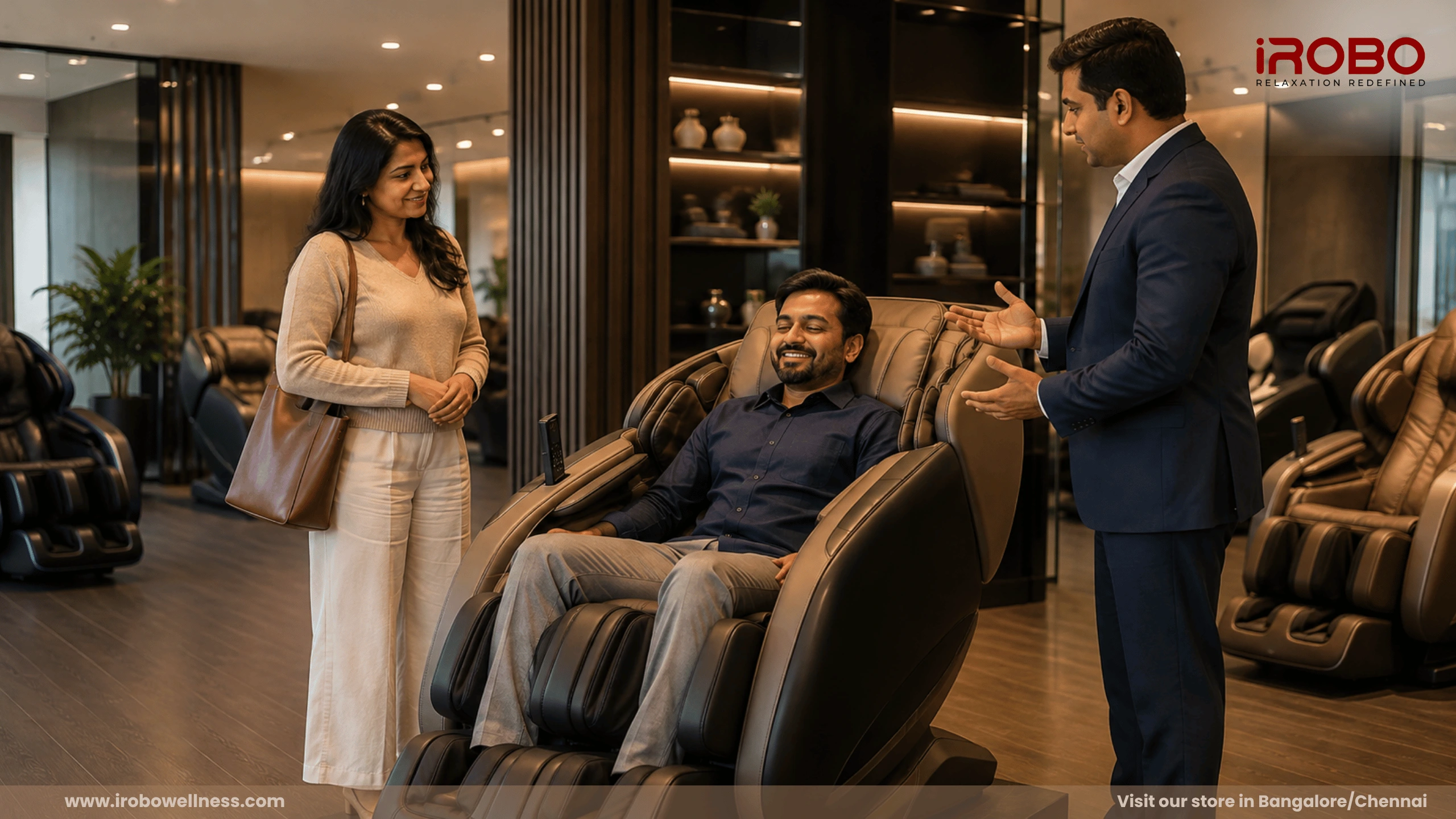
Specs tell you what a chair contains. Ten minutes in it tells you whether it fits. Free trials at our Bangalore experience centres, no obligation.
Before You Buy, Check These 12 Things
- Track type — S, L or SL, and where the roller path actually ends.
- Roller technology — 2D, 3D or 4D, and whether depth is genuinely adjustable.
- Body scanning — does it reposition for your height, and how accurately?
- Coverage — neck, shoulders, back, glutes, arms, calves, feet. Note the gaps.
- Air compression — pressure quality, not airbag count.
- Heat — which zones, and how quickly it warms up.
- Zero gravity — how many stages, and how they feel at your height.
- Controls — can everyone in the house operate it unaided?
- Dimensions — upright and fully reclined, plus required wall clearance.
- Warranty and service — what's covered, for how long, and who services it locally.
- Demo — sit in every shortlisted model, back to back if possible.
- Home fit — where exactly will it live, and is there a power point there?
Final Verdict
Next-gen massage chair technology is real, and the good parts are worth having. Body scanning, SL-track coverage, 3D or 4D rollers and zero gravity change what the massage does to your body. That's not marketing — it's mechanics.
The connected features are a different category. Voice control, apps and Bluetooth make a good chair more convenient. They don't make a mediocre chair good, and a chair that leads with them while staying vague about its roller system is telling you where its budget went.
The best next-gen massage chair isn't the one with the longest feature list. It's the one where the technology translates into a massage that fits your body, your routine and your living room. That's a judgement you can only make sitting down.
A note on health: massage chairs are wellness products designed to support relaxation and may provide temporary relief from everyday muscle tension. They aren't medical devices and don't treat or cure medical conditions. If you're pregnant, recovering from an injury or surgery, or managing a spinal condition, osteoporosis or a heart condition, check with your doctor before regular use.
Frequently Asked Questions
What is a next-generation massage chair?
A massage chair that adapts to the user rather than running a fixed routine. The defining technologies are body scanning, 3D or 4D rollers, an L-track or SL-track, and zero-gravity recline. Connected features like app and voice control are common but aren't what makes a chair next-gen.
What makes a massage chair "smart"?
Two different things get called smart. Adaptive intelligence — body scanning and automatic roller adjustment — changes the massage itself. Connectivity — apps, voice control, Bluetooth — changes how you operate the chair. Only the first affects how the massage feels.
Is a 4D massage chair better than a 3D massage chair?
4D adds variable speed and rhythm within each stroke, so pressure builds and releases more naturally instead of running at a constant tempo. It's a genuine improvement for daily users. But a well-built 3D chair with an SL-track and accurate scanning will out-perform a poorly built 4D chair.
What is body scanning in a massage chair?
Sensors map your shoulder, spine and hip position before the session, then reposition the rollers to match your frame. Without it, the chair massages an average-sized body — which means shorter and taller users get rollers in the wrong place.
What does zero gravity do in a massage chair?
It reclines you with your knees at or above heart level, spreading your weight across the backrest and reducing compression on the lower spine. It also presses your back into the rollers, so the same program feels deeper than it does upright.
What's the difference between an S-track and an SL-track?
An S-track follows the spine's curve from neck to lower back. An SL-track continues past the lower back and under the seat to include glutes and hamstrings. For anyone who sits for long hours, the extended coverage is the more useful of the two.
Is heat therapy in a massage chair useful?
Yes, as a comfort feature. Warmth helps muscles relax so roller work meets less resistance, and it's most noticeable in the first few minutes of a session. A worthwhile premium addition rather than a reason to choose one chair over another.
Are smart massage chairs worth the money?
The adaptive features are — scanning, 3D/4D rollers and SL-track coverage measurably change the massage. The connected features are convenience upgrades. A useful rule: pay a premium for what your body notices, not for what your phone connects to.
Can multiple people use one smart massage chair?
Yes, and body scanning plus saved memory profiles are what make it practical. Scanning adjusts roller position for each person's height, while profiles store individual intensity and program preferences so nobody reconfigures the chair each time.
Do massage chairs have Bluetooth?
Many mid-range and premium models include Bluetooth speakers in the headrest for music or meditation audio. It's a pleasant addition with no effect on massage quality, so it shouldn't influence which chair you buy.
What features should I look for when buying a massage chair?
Prioritise SL-track coverage, body scanning, 3D or 4D rollers, zero-gravity recline and full-body air compression. Then check fit for your height, ease of use, noise level, space needed when reclined, and local service support.
Should I try a massage chair before buying one?
Yes. Roller smoothness, pressure quality, motor noise and whether the chair fits your frame determine daily satisfaction, and none of them appear on a spec sheet. Ten minutes in a chair reveals more than hours of comparison.